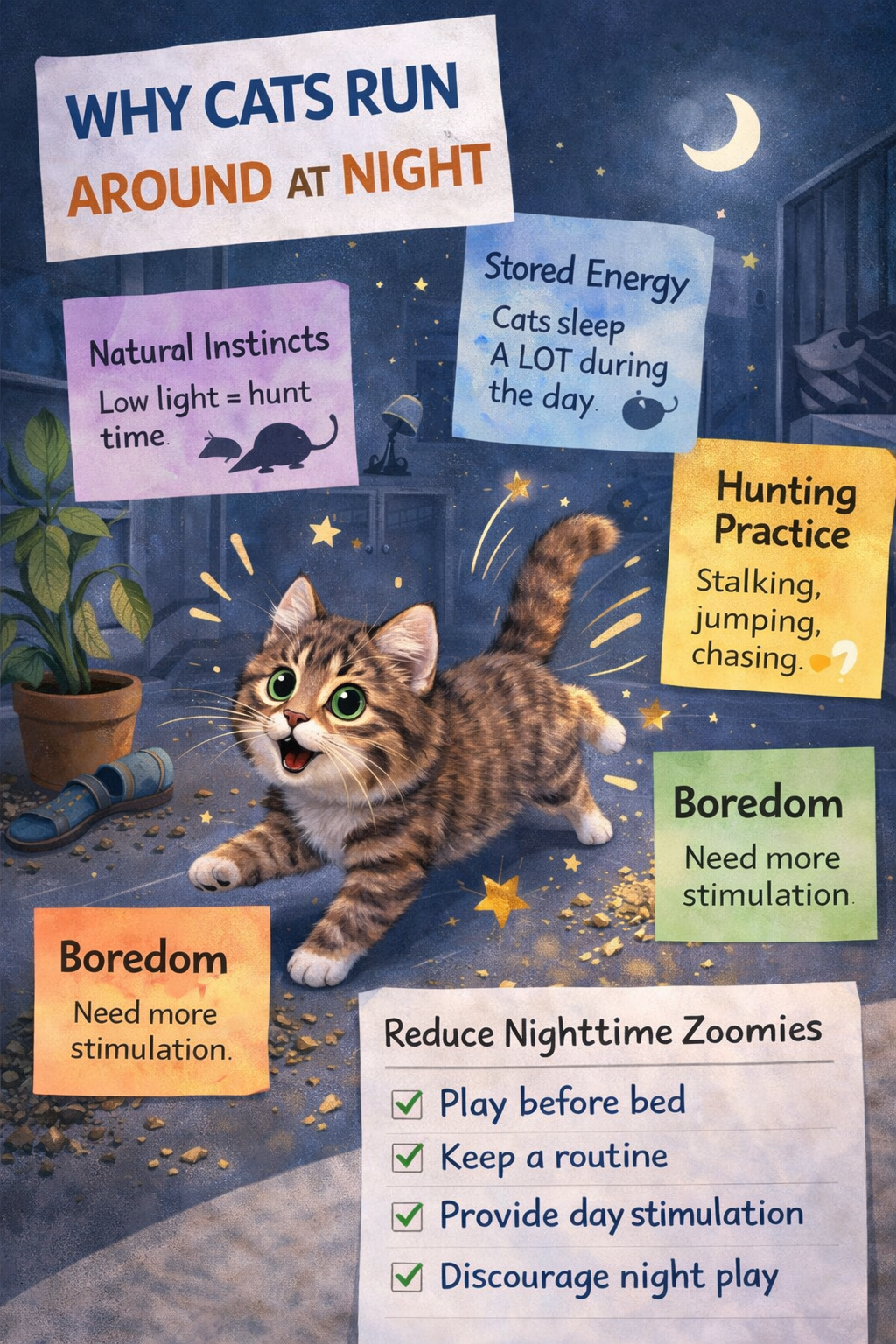

ou are finally ready to sleep.
The lights are off. The room is quiet.
And suddenly…
Your cat starts sprinting across the house like a tiny rocket.
Jumping, sliding, chasing nothing, and knocking things over — usually at 2 a.m.
If you are a new cat owner, this can be confusing (and a little exhausting). But don’t worry.
This behavior has a name.
It is often called “the zoomies.”
And yes — it is completely normal.
Why Cats Become So Active at Night
Cats are naturally more active during the evening and early morning.
This comes from their instincts.
In the wild, cats are hunters. Their bodies are designed to be most active during low-light hours, when prey is easier to catch.
So while you are getting ready to sleep, your cat may be thinking:
“Perfect time to hunt.”
Even if your cat lives indoors and has never seen prey, those instincts are still there.
It Is All About Energy
Another simple reason?
Your cat has too much energy.
If your cat spends most of the day sleeping (which is very normal), all that stored energy has to go somewhere.
And often, it gets released at night.
That is when you see:
- sudden running
- jumping on furniture
- chasing invisible targets
- playful attacks on objects (or your feet)
It may look chaotic, but for your cat, it is just exercise.
Your Cat May Be Bored
Indoor cats especially need stimulation.
If your cat does not get enough playtime during the day, nighttime becomes their “activity time.”
Think of it this way:
If you stayed home all day with nothing to do, you would probably feel restless too.
Cats are no different.
Without enough physical and mental stimulation, they create their own fun — often when you least expect it.
Nighttime Zoomies Are Also Hunting Practice
When your cat runs, jumps, and suddenly changes direction, they are not just being random.
They are practicing hunting behavior.
You might notice:
- stalking movements
- sudden bursts of speed
- jumping onto invisible targets
- attacking small objects
Even if there is nothing there, your cat is acting out natural instincts.
It is actually a healthy behavior — just not always convenient for humans.
Why It Feels So Loud at Night
During the day, your home has background noise.
At night, everything is quiet.
So when your cat starts running, every sound feels louder:
- paws hitting the floor
- objects moving
- scratching sounds
- sudden jumps
The behavior is not necessarily more intense — it just feels that way because of the silence.
How to Reduce Nighttime Zoomies
You cannot completely remove this behavior.
But you can manage it.
The goal is simple:
Help your cat use that energy earlier in the day.
1. Play With Your Cat Before Bed
This is the most effective solution.
Spend 10–15 minutes actively playing with your cat in the evening.
Use toys like:
- feather wands
- laser pointers
- small moving toys
- interactive toys
Try to simulate a hunting session:
- chase
- catch
- repeat
This helps your cat release energy before bedtime.
2. Feed After Playtime
After playing, give your cat a meal.
This follows a natural cycle:
hunt → eat → relax → sleep
Many cats become calmer after eating, which can reduce nighttime activity.
3. Keep a Consistent Routine
Cats love routine.
If your cat eats, plays, and sleeps at similar times every day, their behavior becomes more predictable.
Irregular schedules can make nighttime energy bursts worse.
4. Provide Daytime Stimulation
If your cat is alone during the day, try adding:
- window perches
- puzzle feeders
- interactive toys
- safe climbing spaces
Even simple changes can reduce boredom.
5. Avoid Encouraging Night Play
If your cat wakes you up at night and you respond by playing, feeding, or giving attention, your cat may learn:
“Nighttime = attention time.”
Try to stay consistent and avoid reinforcing the behavior.
This part can be difficult, but it makes a difference over time.
When to Be Concerned
Zoomies are normal.
But if your cat shows:
- extreme restlessness
- constant pacing
- unusual vocalizing
- sudden behavior changes
It may be worth checking with a veterinarian.
Especially if the behavior is very different from usual patterns.
Final Thoughts
Nighttime zoomies can feel frustrating, especially when you are trying to sleep.
But in most cases, it is simply your cat being a cat.
It is energy, instinct, and play — all combined into one fast, chaotic moment.
Instead of trying to stop it completely, focus on:
- adding playtime
- creating a routine
- reducing boredom
With a few small changes, those late-night sprints can become much more manageable.
And who knows…
You might even start to find them a little funny.
Leave a Reply