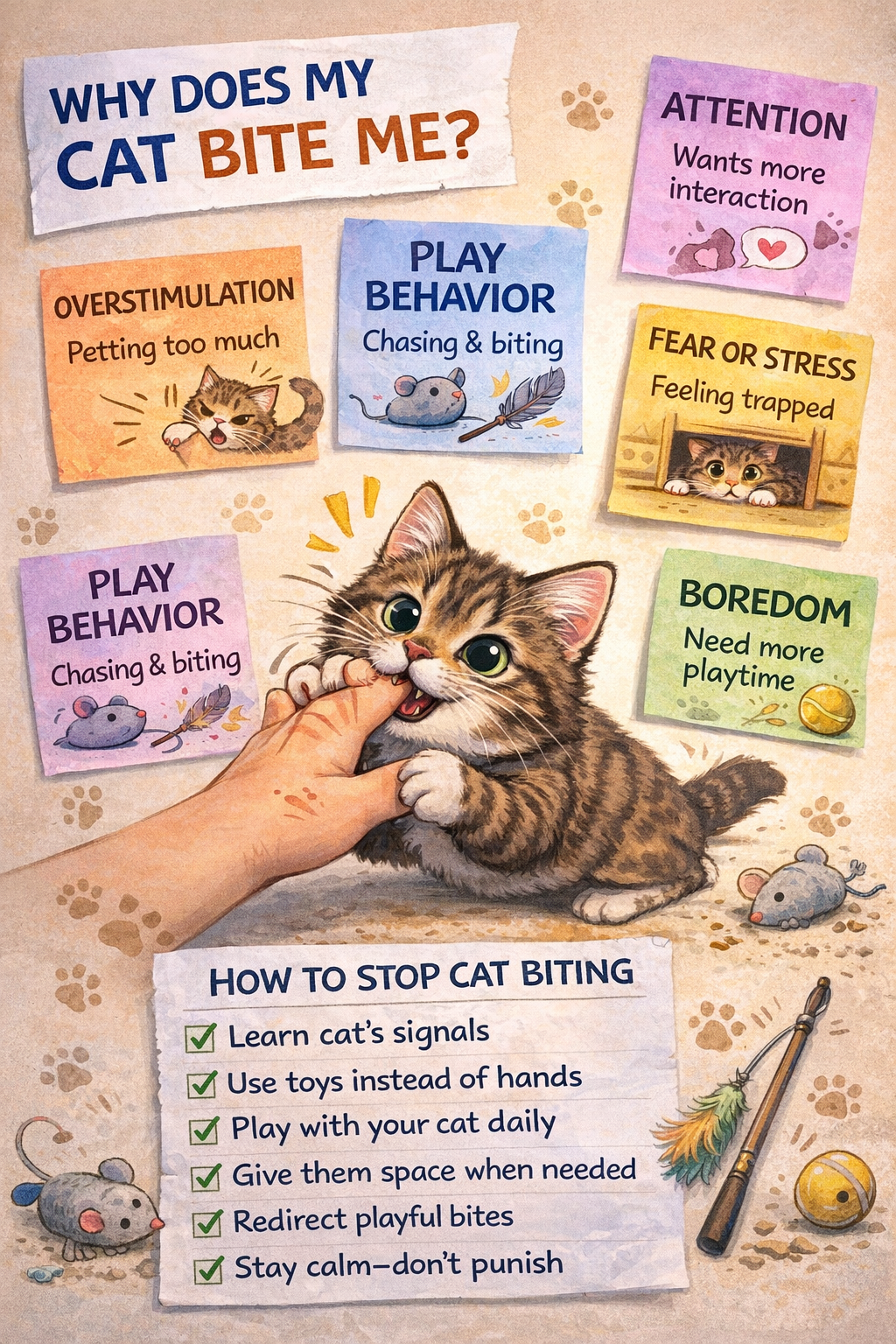

One moment, your cat is calm and relaxed.
The next moment…
you get bitten.
Not always hard. Sometimes just a quick nip.
But still — confusing, right?
If you are a first-time cat owner, this can feel frustrating.
“Why did my cat bite me?”
“Did I do something wrong?”
“Is my cat aggressive?”
The good news is this:
Most cat biting is not aggression.
It is usually communication.
Cats Do Not Bite for No Reason
Cats rarely bite “out of nowhere.”
It may feel sudden to you, but your cat is almost always reacting to something.
The problem is that cats communicate differently than humans.
Before biting, many cats give warning signs.
You just might not have noticed them yet.
1. “I’ve Had Enough” (Overstimulation)
This is one of the most common reasons.
You are petting your cat. Everything seems fine.
Then suddenly — bite.
What happened?
Your cat likely became overstimulated.
Some cats enjoy petting… but only up to a certain point.
Warning signs before a bite:
- tail flicking or swishing
- ears turning sideways or back
- body becoming tense
- sudden stillness
- skin rippling
If you keep petting after these signals, your cat may bite as a way of saying:
“Stop.”
2. Play Biting (Especially in Young Cats)
Kittens and young cats often bite during play.
To them, your hands may look like moving toys.
So they:
- chase your fingers
- grab your hand
- bite lightly
- kick with their back legs
This is not aggression.
It is play behavior.
But if you allow it too much, your cat may continue the habit as they grow.
3. Boredom and Energy
A bored cat is a creative cat.
If your cat does not get enough playtime, they may use you as entertainment.
This often looks like:
- attacking your feet
- biting your hands
- jumping on you unexpectedly
This is especially common at night or early morning.
It is not personal.
Your cat just has energy to burn.
4. Fear or Stress
Sometimes biting is defensive.
If your cat feels scared, cornered, or uncomfortable, biting can be a way to protect themselves.
This may happen when:
- picking up your cat unexpectedly
- approaching too quickly
- introducing new people or pets
- loud environments
In these situations, the bite is more of a warning:
“I don’t feel safe.”
5. Petting in Sensitive Areas
Not all cats like being touched everywhere.
Common sensitive areas include:
- belly
- tail base
- paws
- lower back
Even if your cat shows their belly, it does not always mean they want it touched.
Some cats enjoy it.
Many do not.
6. Attention-Seeking Behavior
Yes — sometimes cats bite because they want attention.
If your cat notices that biting leads to:
- you talking
- you moving
- you reacting
They may repeat the behavior.
Even a small reaction can reinforce it.
7. Medical Issues (Less Common, But Important)
If your cat suddenly starts biting more than usual, it could be related to discomfort or pain.
A normally calm cat that becomes aggressive may be trying to tell you something is wrong.
If the behavior is:
- sudden
- frequent
- stronger than usual
It is worth paying attention.
How to Stop Your Cat From Biting
The goal is not to punish your cat.
It is to understand the reason and respond correctly.
1. Learn Your Cat’s Signals
This is the most important step.
Watch your cat carefully.
If you notice:
- tail flicking
- ears turning back
- body tension
Stop before the bite happens.
Prevention works better than correction.
2. Do Not Use Your Hands as Toys
This is a big one.
If you play with your cat using your hands, your cat learns:
“Hands = something to bite.”
Instead, use:
- wand toys
- feather toys
- balls
- interactive toys
Keep your hands out of direct play.
3. Increase Daily Playtime
A tired cat is a calm cat.
If your cat has too much energy, biting becomes more likely.
Try:
- 10–15 minutes of play
- once or twice a day
- especially before bedtime
This helps release energy in a healthy way.
4. Stop Interaction Immediately After a Bite
If your cat bites, do not shout or hit.
Instead:
- stay calm
- slowly move your hand away
- stop interacting
This teaches your cat that biting ends the fun.
5. Respect Your Cat’s Boundaries
Not all cats like the same level of contact.
Some love being held.
Some prefer distance.
That is okay.
Learning your cat’s comfort level builds trust.
6. Redirect, Do Not Punish
If your cat is in a playful biting mood, redirect that energy.
Give them:
- a toy
- something to chase
- something to bite safely
Punishment often increases fear and stress.
Redirection works much better.
Final Thoughts
If your cat bites you, it does not mean your cat is “bad.”
It usually means your cat is trying to communicate something:
- “I’m overstimulated”
- “I’m bored”
- “I’m scared”
- “Play with me”
- “Stop touching me”
Once you understand the reason, the behavior becomes much easier to manage.
With a little observation, better play habits, and respect for your cat’s signals, biting can be reduced significantly.
And over time, your cat will learn a better way to interact with you.
Leave a Reply